Chess Academy
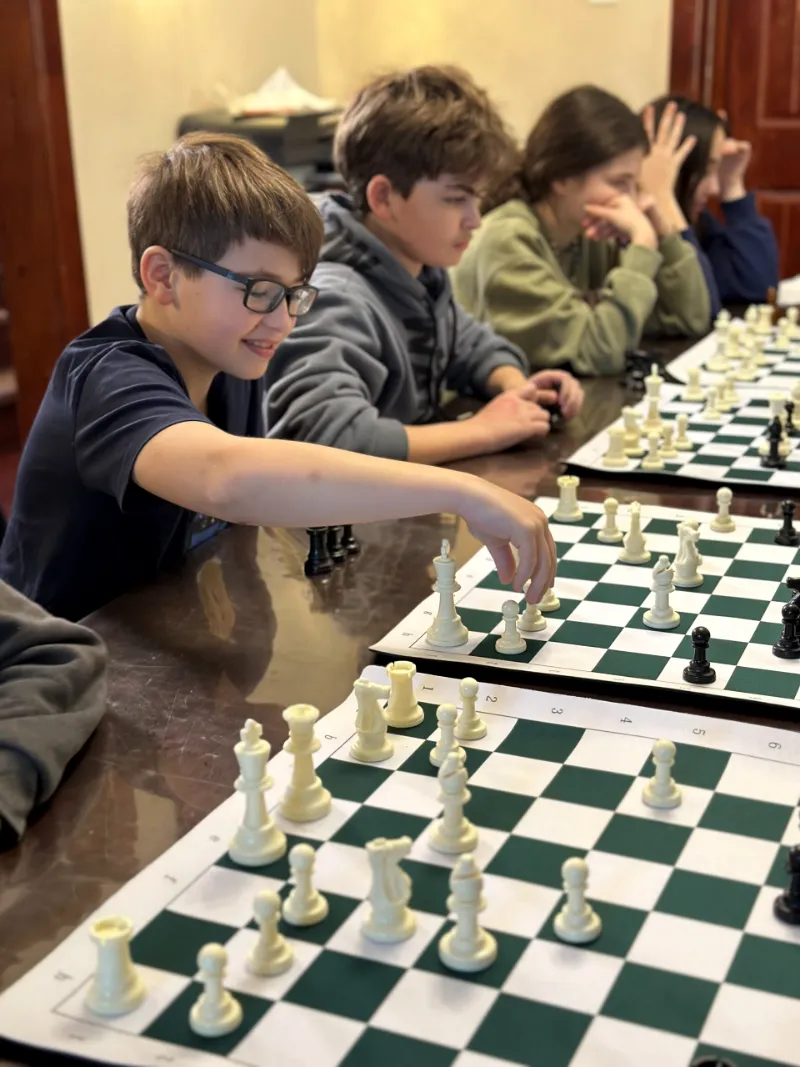
Think · Plan · Win
$160 per month · all classes at your level
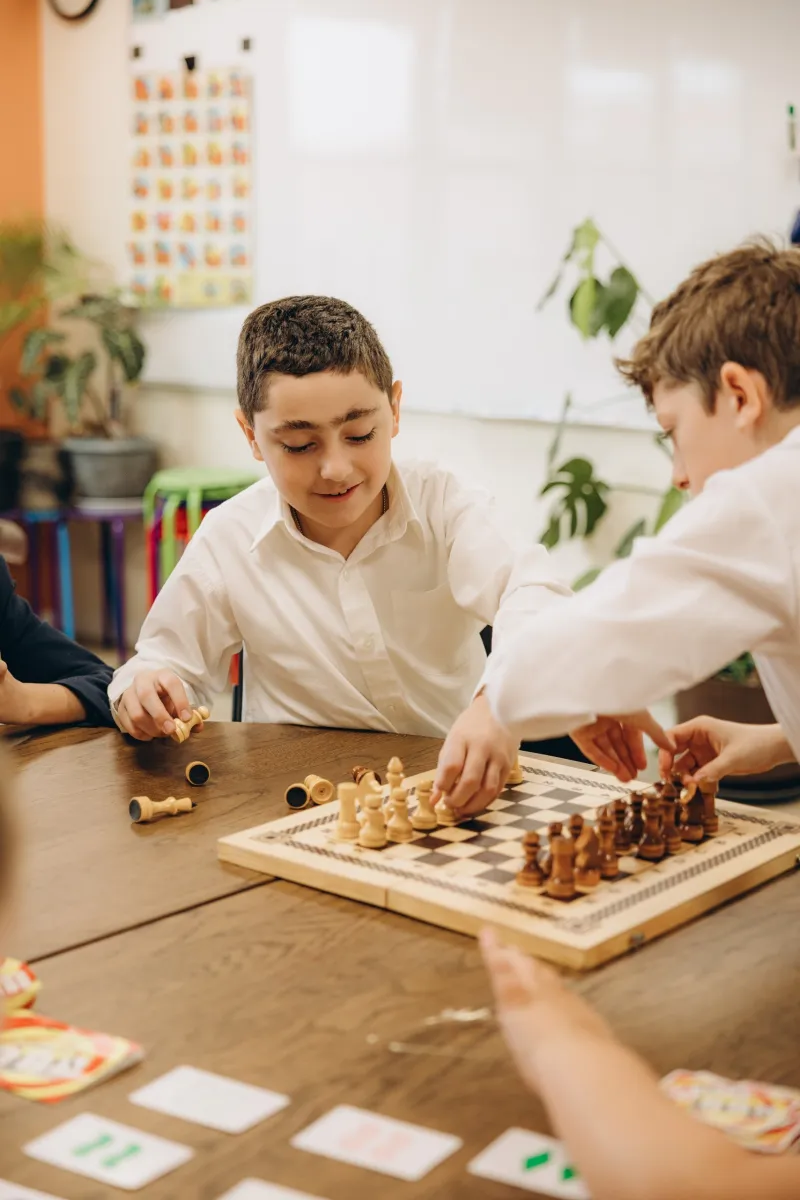
Four afternoons a week in Brighton Beach, your child learns to sit with a hard problem, think two moves ahead, and stay calm under pressure. Small groups, two coaches on strategy days, and rated tournament play from the first year.
Sign up for a free trial lesson
23 Brighton 11th Street, Brooklyn NY 11235 · Monday–Thursday after school · Open to students from any school
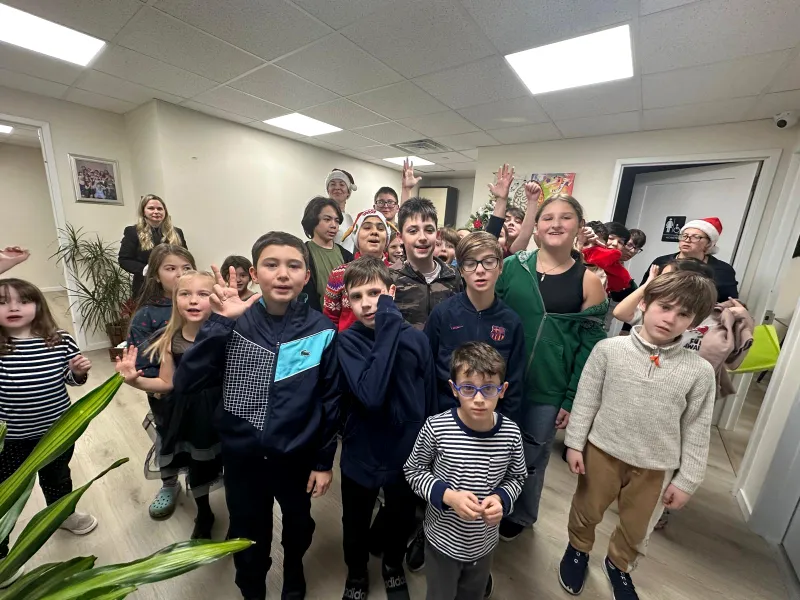
Your Child Joins the Group That Fits
Two grade-based groups, plus an invitation-only competitive track. If you're not sure where your child belongs, the coach will tell you after the trial lesson.
Strategic Beginnings
Grades K–2
For children who have never played. We start with how each piece moves and build to a first full game.
- Piece movement and board setup
- Checkmate in one and two moves
- Simple opening principles
- Playing a game start to finish
- 12 students max · Mon–Thu
Calculated Thinkers
Grades 3–6
For players who know the rules and want to stop losing pieces. Tactics, patterns, and guided play.
- Forks, pins, skewers, discovered attacks
- Reading the board before moving
- Endgame basics
- Puzzle drills and coached games
- 16 students max · Mon–Thu
Champions Circle
Grades 3–12 · By invitation
A competitive track that runs alongside the regular groups. Coaches invite players who are ready for rated play.
- Opening repertoire and preparation
- Deep position analysis
- Game review with a coach
- USCF tournament preparation
- 12 students max · Tue & Thu
Champions Circle is not the next step up — it runs in parallel. A strong fourth-grader can attend Calculated Thinkers on Monday and Wednesday and Champions Circle on Tuesday and Thursday, at no extra cost.
Come as Often as You Like
One monthly price covers every session your child's level is running. Miss a Monday, come on Wednesday — nothing to reschedule and nothing extra to pay.
- Monday
- Tuesday
- Wednesday
- Thursday
- Friday
- Monday
- ♟Strategic Beginnings
- 3:00 – 4:15 PM
- 12 students max
- Tuesday
- ♜Calculated Thinkers
- 3:00 – 4:15 PM
- 16 students max
- Wednesday
- ♟Strategic Beginnings
- 3:00 – 4:15 PM
- 12 students max
- Thursday
- ♜Calculated Thinkers
- 3:00 – 4:15 PM
- 16 students max
- Off
- No classes Friday
- ♜Calculated Thinkers
- 4:30 – 5:45 PM
- 16 students max
- ♟Strategic Beginnings
- 4:30 – 5:45 PM
- 12 students max
- ♜Calculated Thinkers
- 4:30 – 5:45 PM
- 16 students max
- ♟Strategic Beginnings
- 4:30 – 5:45 PM
- 12 students max
- ♛Champions Circle
- 5:00 – 6:00 PM
- 12 students max
- By invitation
- ♛Champions Circle
- 5:00 – 6:00 PM
- 12 students max
- By invitation
- Tuesday & Thursday: two parallel groups, two coaches
- Doors open 15 minutes before each session
- No classes on BSE holidays and school breaks

Where the Learning Gets Tested
Chess only becomes real when a child plays someone they've never met, with a clock running. We build toward that from the start.
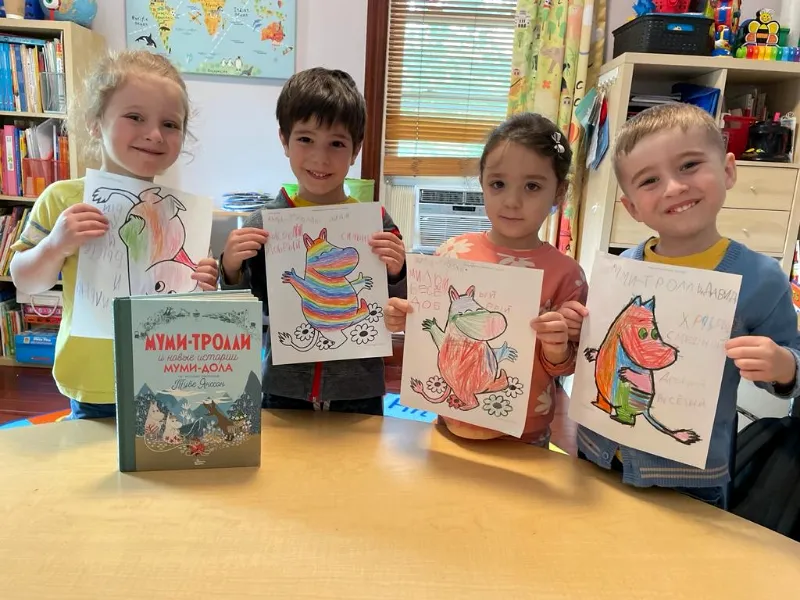
In-House Rated Tournaments
We run our own rated events regularly, so a child's first competition happens on familiar boards with familiar faces — no travel, no entry fee, no pressure to be ready.
USCF Tournament Preparation
Coaching goes past strategy into what rated play actually demands: clock management, notation, tournament rules, and holding your nerve in a long game.
Local to International Play
Students who are ready compete at local, regional, national and international tournaments, with coaches preparing them for each one.
Quarterly Progress Reports
Every quarter you get a written report on what your child has learned, where they've improved and what the coach is working on next. No guessing.
What Parents Notice First
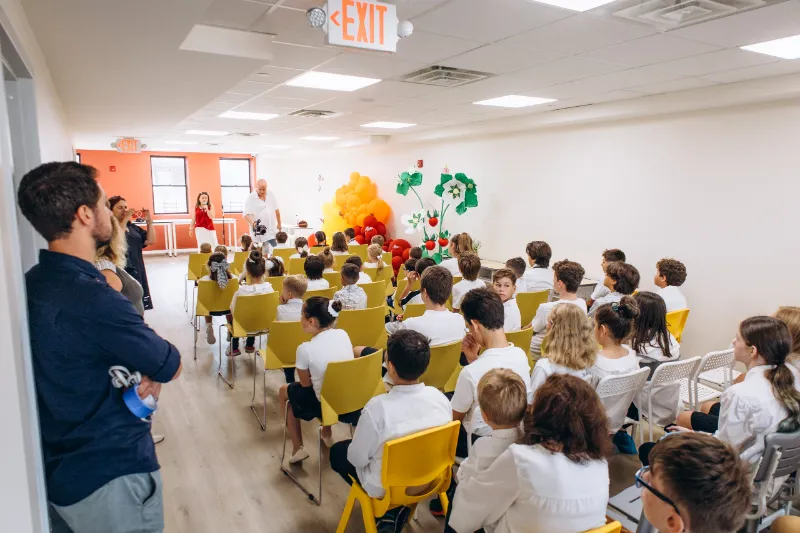
Longer Attention
A full game asks for forty minutes of unbroken focus. That habit follows children into homework.
Thinking Before Acting
Every move has a consequence you can see on the board. Children learn to check themselves first.
Losing Well
Nobody wins every game. Reviewing a loss with a coach turns frustration into a next step.
A Circle of Friends
The same small group meets four days a week. Rivalries here tend to turn into friendships.
Who Your Child Will Work With
A titled player and a tournament director — one who has competed at the highest level, one who has spent years building chess programs for children in South Brooklyn.
Kakha Khaburzania
International Master · FIDE 2300
Kakha brings decades of competitive play to the board and has been teaching since 2022, from children learning how the pieces move to advanced players preparing for rated competition. He is unusually good at taking a complex idea apart and rebuilding it in language a child can use.
He also holds a degree in mathematics and has years of experience tutoring middle-school students, which shows in how he teaches calculation and pattern recognition. He speaks Georgian and Russian as well as English.
Collin Holson
USCF Certified Tournament Director
Collin led the chess club at Wesleyan University, where he built a community of players and expanded opportunities for competitive play. In 2023 the Connecticut State Chess Association named him Volunteer of the Year for his work organizing tournaments across the state.
He has spent the past year teaching and developing chess programs across South Brooklyn. A self-taught player himself, he knows what curiosity and stubbornness can do for a student who is willing to keep going.
There Is an Actual Syllabus
Children do not simply play games for an hour. Each stage has material to cover, and a coach knows exactly what your child has learned and what comes next.
- Intro
- Under 300 Elo
- Piece names and how each one moves
- Captures, check, checkmate, promotion
- Square names, ranks and files
- Ladder mate and back rank mate
- Castling
- Helper mates and Scholar’s mate
- Notation and clock use
- Intermediate
- 300–700 Elo
- Knights toward the center
- Rooks on open files
- Castling early
- Checkmate with queen alone, rook alone
- Forks, pins and skewers
- Prophylaxis — the moves that stop a plan before it starts
- Advanced
- 700–1200 Elo
- French, Caro-Kann, Queen’s Gambit, Sicilian
- Attacking the uncastled king
- King’s and Queen’s gambits
- Opposition and shouldering
- Deflection, interference, overloaded pieces
- Outposts and ideal squares
- Annotation symbols
- Highly advanced
- Above 1200 Elo
- Isolated pawn positions
- Building an opening repertoire
- Theoretical endgames
- Bishop and knight checkmate
- Closed positions and pawn breaks
- Lucena position and triangulation
- Master games we study
Read more
Advanced students work through annotated classics rather than abstract exercises — Capablanca on deflection, the Opera Game for development and the pin, Fischer–Spassky on color complexes, Kasparov–Karpov on the knight outpost, Rotlewi–Rubinstein on active pieces, Steinitz–Von Bardeleben on building an attack. Roughly seventeen games in all, each chosen to teach one idea clearly.
One Price, No Add-Ons
- $160 per month · billed monthly
- Every class at your child's level, plus rated play
- Sign up for a free trial lesson
01 — Four sessions a week at your level — Monday through Thursday, plus two more if your child is invited to Champions Circle.
02 — Two coaches on strategy days — Tuesday and Thursday run two parallel groups, so attention stays individual.
03 — Rated tournament play — Practice and entry to the Academy's in-house rated tournaments are included.
04 — All equipment provided — Boards, clocks and materials belong to the Academy — nothing to buy.
Read more
05 — Level changes are free — Move up mid-year on the coach's recommendation at no extra cost.
06 — Quarterly progress reportA written summary of your child's development every quarter.
My child has never played. Is that a problem?
No. Strategic Beginnings assumes zero experience — we start with how the pieces move. Most children play their first full game within two weeks.
What exactly does $160 a month cover?
Every session your child's level runs that month — four a week, Monday through Thursday — with two coaches on the parallel strategy sessions. Equipment is provided, in-house rated tournaments are included, and there is no per-class fee. Billing is monthly.
Can we try a lesson first?
Yes, the trial lesson is free. Your child joins a real session with the group they'd be placed in, and afterwards the coach tells you which level fits.
What if we miss a week?
Nothing to reschedule. Your child can attend any other session at their level that week — there's one almost every day.
How does a child get into Champions Circle?
By coach invitation, from third grade upward. It runs in parallel with the regular groups rather than replacing them, so an invited player keeps attending their own level as well — at no extra cost.
Do students play in real tournaments?
Yes. The Academy runs its own rated tournaments regularly, and students who are ready compete at local, regional, national and international events with their coach's preparation.
How will I know my child is improving?
You receive a written progress report every quarter covering what your child has learned, where they've grown, and what the coach is working on next. Coaches are also available after any session.
Where are classes held and when do they pause?
All sessions run at 23 Brighton 11th Street, Brooklyn NY 11235, and the room opens 15 minutes early so children can settle in. There are no classes on Brooklyn School of Excellence holidays and school breaks.
Do you have to be a BSE student to enroll?
No. The Chess Academy is open to all children, from any school in the neighborhood.
Sign Up for a Free Trial Lesson
Tell us your child's grade and we'll confirm a session by phone within one school day.
Send the School a Message
Try a Puzzle: White to Move, Mate in One
The kind of position Strategic Beginnings students solve in their first month. Tap the white piece you want to move, then its square.
Hint: Black's king is boxed in by its own pawns.
See BSE in Person.
Tours run on school days, so you see real classes. Bring your child; we'll meet them too.